Sunday, July 3, 2016

3 Simple Ways to Help the Earth


Recycling turns things into other things. 
 Which is like magic.

Living a greener life has become a very common goal here in the western world.  I would suggest that it is actually our responsibility to do so as a citizen of this planet.   There are some easy ways to greenify your life and all it takes is a bit of planning on your part to Reduce, Reuse, and Recycle. 

Reduce
This is the most important of these three activities.  If you don't have the waste to begin with then you don't have to bother to get rid of it.  I had a professor in college that used to tell us that "Everything goes somewhere.." This I found out later was one of the laws of ecology as stated by ecologist and physicist Barry Commoner. You can't throw something away and think it disappears.  Anything you put in the garbage, dump down the drain, or on the earth goes someplace.  It goes to water treatment where all that stuff is taken back out of the water and then put in a landfill somewhere.  It could go into a landfill and stay there for much longer than you will be alive.  It could blow around on the earth until its blown into a river. I can tell you from observation that most trash that makes it into a waterway does not come out.  Maybe it goes all the way to the ocean and collects there or traps some helpless animal. Reducing waste sounds like a good idea.  The absolutely easiest way to reduce plastic is to stop using those annoying and very destructive plastic shopping bags.  Take reusable bags to the store.  I saw many people doing this when I was travelling in England but it still hasn't caught on in the US as much.  What if we all did it?  Believe me, those plastic bags will be illegal someday so start today.  

I signed a pledge to protect sea life by not using plastic straws a few years back.  It didn't seem like a big thing to do.  That was until I found out just how often you use those little disposable plastic straws.  Can you imagine how many you actually use in one year?  How about your whole family? It turns out that the citizens in the United States use about 500 million plastic straws a year.  They aren't recyclable or biodegradable because petroleum plastics are designed to last FOREVER so they just sit in landfills or litter our waterways and beaches. They are one of the top 10 marine debris items. One straw can kill a dolphin or seal who unfortunately do accidentally ingest them.  Thinking of a few one use plastics that you could give up for good could really help.  I ended up just not using straws for a long time. I had heard they caused wrinkles around your mouth anyway! Unfortunately, sometimes I would actually miss a straw so I searched for an alternative.  I now have some great stainless steel straws that can be reused.  You can find them here

Reuse
It takes energy and transportation to recycle things so reusing is still more beneficial than recycling.  A great place to get ideas for reusing things you buy is pinterest.  Search reuse ideas and you will come up with some things you haven't thought of before to reuse, and upcycle.  The picture of the bird feeder is one of my favorites for broken dishes and china. I have a broken crystal bowl that I have used for fruit for 20 years that I will be using as a planter in my garden very soon. Other things that can be reused are plastic containers from food items and those annoying plastic bags! Anything that doesn't go immediately into the trash helps the earth.


Recycle
If you still have things left over after reducing and reusing you will need to recycle.  Recycling is a small amount of effort for a big payoff for the earth.  Check with the city you live in for what can be recycled in your area.  It is also helpful to know if you need to rinse out the things you recycle and if you can recycle glass.  If you recycle everything you can you will probably end up having less trash than recycling.  Things that I can't recycle like clothing and furniture usually go to charity as a donation.  

Another way to recycle organics is to compost your food scraps.  This composes a large amount of the waste that ends up in landfill year after year.  Grass clippings, egg shells, fruit and vegetable peelings, teabags and many other items can be composted to make high quality soil for your garden.  If you live in a desert like myself you will need to add water to make this work.  This is a great article for composting in the desert here.

I will end this with an earth blessing that I like to say because I love the earth and its inhabitants and hope I have made a difference when my time is done here.


I bless the earth and all her creatures
Serpent, dolphin, wolf, and owl
Bring forth human care and understanding
To impart an earth that is not so foul
Precious are her many realms
Of land and sea and sky so fair
Protection, action, and compassion
All of these I vow and swear


Friday, January 16, 2015

Teaching Children to Love the Earth


Come away, O human child!
To the waters and the wild
With a faery, hand in hand,
For the world's more full of weeping 
than you can understand.
                                                    -William Butler Yeats

Faced with the realization that our Earth is in trouble ecologically and that most scientists believe we are in the middle of a sixth extinction event, the question of teaching our children to care about our planet is a very timely one. Children today are increasingly "plugged in"to say the least.  If they happen to venture outside they are usually wearing headphones and effectively tuning out the world. Conversely, unplugged children are resilient and natural leaders in the outdoors if given the opportunity.  To teach them to love the earth is simple.  Get them outdoors to experience nature and the love of the earth will come all on its own. Here are some fun ways to do just that.

1.  Plant Something
This can be as easy as a planter full of cherry tomatoes.  Start small with this one, it doesn't take a large garden to reap the benefits of getting dirty hands and watching something grow.  Plants are magical!  My own daughter is so excited to eat something that she has grown in the garden.  We planted this fairy garden of herbs a couple summers ago.  These plants still end up in all sorts of dishes in our home.


2.  Take a Hike
Not all those that wander are lost!  I am lucky that I live in the southwest in beautiful country.  A few hours from Phoenix and you find yourself in the blissful forests of Flagstaff.  Taking a hike is not only good exercise for kids but it surrounds them with earth's grandeur.  When my brother and I were young our parents told us that we could hike anywhere we wanted within site of our camp.  What freedom that was!  We got to know the outdoors on our terms.  This set the stage for our deep love for the earth and probably my geology degree!  Hiking is a must do for children.

3.  Visit a National or State Park
It is always amazing to me how many children in my classroom in Phoenix tell me they have not visited the Grand Canyon when it's a few hours up the road!  These are places that have been set aside for their spectacular scenery and earth history.  Most of my fondest memories of childhood were of time spent in a national park.  The United States boasts some of the most extraordinary natural settings in the world.  Get out there and use them!  Your kids will thank you!


4. Visit an Animal Sanctuary or Nature Center
If you are lucky enough to have one of these in your area definitely visit.  These places usually have wonderful hands on activities and exhibits.  Many teach children about threatened or endangered animals and teach kids to pay attention to animals in their environment.  We have a butterfly sanctuary near our home.  I like to visit because it is a real "zen" moment with butterflies the size of your hand fluttering around.  They have a great film on the monarch  butterfly and why it is decreasing in number as well.


5.  Get Involved in Conservation 
You undoubtedly build a future for our planet if your kids understand that animals are vulnerable because of our activities.  There are probably many groups in your area that work to conserve animals and their habitats.  In the Phoenix metropolitan area we have threatened burrowing owls.  These owls live underground in burrows usually made by a rodent of some kind.  I have also seen them in storm drains and irrigation ditches.  The are threatened by urban sprawl and anything that may cover their burrow.  Working to relocated and build new homes for these birds is something my seventh graders do as a part of our ecology unit.  They work very hard to build something that is very important to this tiny bird.  They look at their roll as stewards of the earth very differently after this project.

Finally, to understand the benefits of getting children into nature please read Last Child in the Woods by Richard Louv.  It is a wonderful book that really describes the difference between today's plugged in child and children of the past and what we can do about it.

Wednesday, January 14, 2015

Teaching Science Through Mastery Learning

Mastery learning is not a new concept.  It has been alive and well since the 1970's.  In a nutshell, it allows students to only move on when they have mastered a concept. How do you know when they are ready?  You test them. If they don't pass the test then they must go back and review until they pass.  Unfortunately, it isn't utilized enough in public education. This may be due to time constraints in the classroom, as well as, the amount of planning it requires at home.  Why would a teacher want to attempt this?

Benefits
The benefits to teaching using a mastery learning model are many.  If you let your students choose the activities they want to do, your engagement in your class will skyrocket.  This only really works if you have many activities that are exciting and varied.  Science lends itself well to this because teachers can integrate hands on projects into the unit along with written activities. In addition, students actually work harder using this model.  What?  That can't be right!  Amazingly enough, it is.  My students actually had more work to do during our mineral unit this year, but got more accomplished in a shorter amount of time.  I believe it is something to do with control.  If they believe they are in control, they work harder and are more motivated.  That leads us to a wonderful side effect of teaching in this way, higher grades!    If students have to pass a test to move on then guess what, they pass!  My students have higher grades and a deeper understanding of relatively difficult concepts when I teach expecting mastery learning.

Setup
Now comes the hard part....planning.  I would start with one unit at a time.  Maybe not all of your units will work using this type of model.  I started with my minerals unit which I am very passionate about.  I used a menu type plan which I called Menu O' Minerals.
Everything in the Appetizer category must be done.  These are mostly teacher directed activities.  In my case it was mostly notes and a reading activity using a thinking map.  The main course has different expectations.  I kept one mandatory activity in this section called mineral ID lab.  After they finished this lab they were required to complete 4 other activities and then take a test.  If they passed the test they earned a grade of a 3, which is "meeting standards" in our district. If they did not pass they did two more activities and retested. Students who had passed the test then had a choice to do two additional projects (dessert) to earn a 4, which is an exceeding score.  The difficultly lies in choosing activities that motivate and move students to a deeper understanding of the topic, and at the same time, managing a myriad of projects at once.

Conclusions
My initial thought was that students would stop when they passed the test, but miraculously this was not the case.  Most students passed the test and went on to complete the final projects.  In fact, when asked what their favorite topic in science was for the first semester, a majority of students chose minerals.  This may be the answer to the "inch deep and mile wide" teaching  that is so prevalent in most science classrooms today.  In any case, the benefits of increased motivation, higher grades, and deeper understanding far outweigh any planning obstacles.  In fact, mastery learning could be modified to fit any grade level or content area.

Saturday, February 8, 2014

Valentines for Dolphins

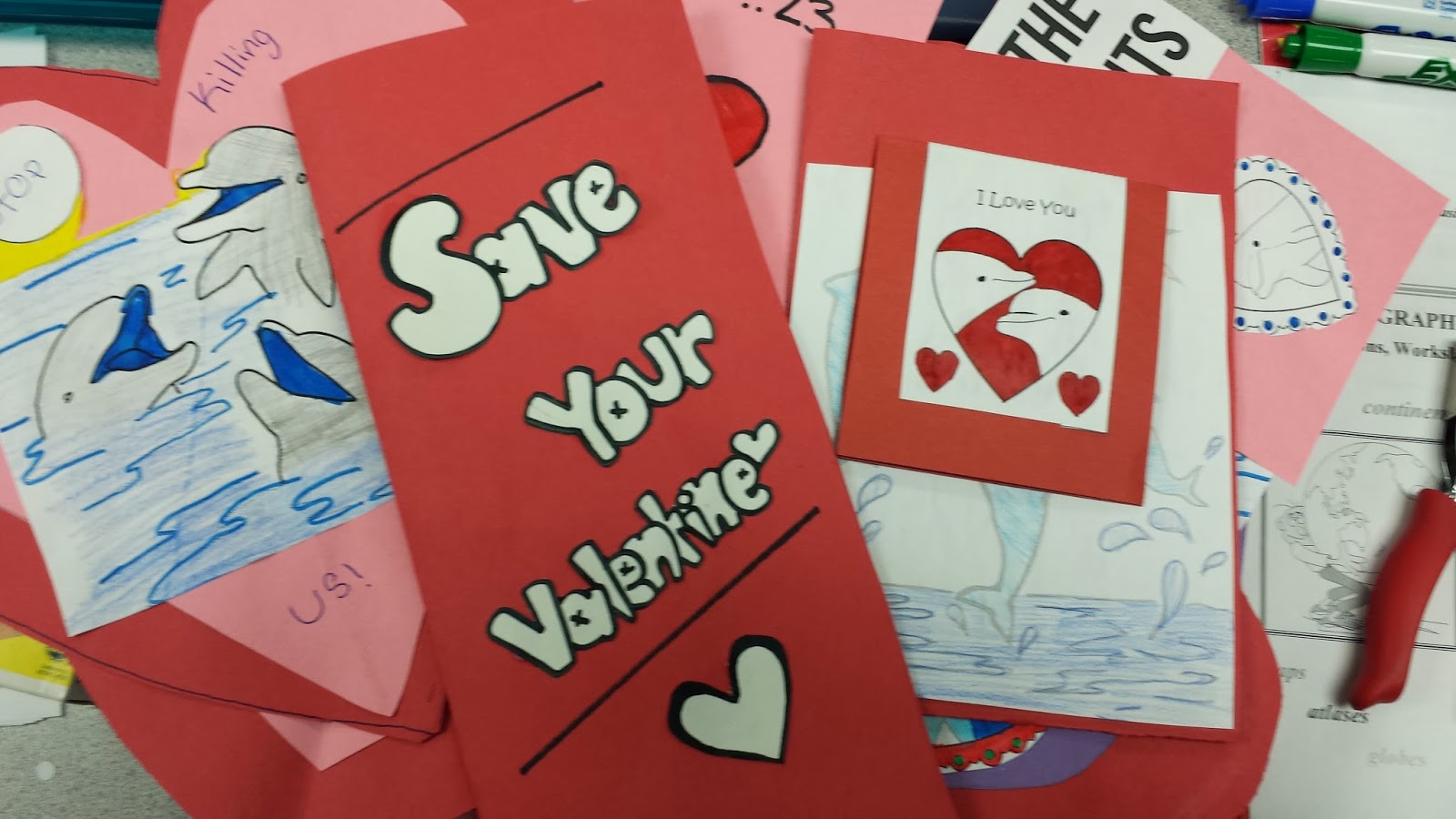
In trying to find some way for my 7th graders to come to the aid of marine mammals, mainly the dolphins who migrate along the coast of Japan, I came across a unique way to protest.  This week of Valentine's Day will be a week of demonstrations against the inhumane treatment of dolphins culminating with protests on Valentine's Day.  It is called World Love for Dolphins Day.  One way to let your students be involved without actively protesting outside an embassy is to send dolphin valentines to the Japanese ambassador in Washington.

My students had the option of making a valentine or not.  Here are some of the ones that were sent to make it there just in time for Valentine's Day.

I think that this helped my students with being able to actively do something and speak out.  The address to send your own valentines is:

Ambassador Kenichiro Sasae
c/o The Embassy of Japan in Washington, D.C.
2520 Massachusetts Avenue N.W.
Washington, DC 20008


Saturday, January 25, 2014

What Can You Do About the Dolphin Hunt in Japan


On Monday this week I was bombarded by my students coming into class and talking about the dolphin drive in Japan.  The two questions that were asked the most were "Why?" and "How can we help?"  Seventh graders are sophisticated enough to demand good answers to these questions.

The "why?" is a very good question.  Japan wants you to believe they are some kind of tradition and therefore not something that should be changed.  The truth is these hunts were very rare until 1969.  There were only a few in the 1930's and 1940's.  The main driving force behind these hunts is money.  Some of the dolphins are sold into captivity for $150,000.00 or more.  The rest are either slaughtered for meat or returned to the sea without a great portion of their pod.  Some of the ones returned to the sea don't make it due to injuries or the loss of their mothers etc.  There has also been some talk that the killing is continuing because the dolphins themselves are seen as pests, and competition for fish.  In any case, the "why?" is very hard to understand.  These are unique social creatures who recognize their own reflection in a mirror, and have complex interactions with each other.  They may even have their own language.  It reminds me of a quote in the book Divergent by Veronica Roth, "Human reason can excuse any evil."  It appears the reasoning behind this evil is money, competition and so called tradition.

How You Can Help

There are a number of things you can do to help the dolphins in Taiji, Japan.  WAZA the World Association of Zoos and Aquariums could actually move to expel JAZA, Japan Association of Zoos the Aquariums because their members are violating their code of ethics.  Drive hunting is a true violation of this code.  To submit a letter to let WAZA know they need to clean up their act click here.

Boycott anything that showcases marine mammals and whale shows.  This includes Sea World and other aquariums and dolphinariums.  To take a pledge that you will never visit a dolphin or whale show click here.

Donate money to help the people on the frontlines in Japan here.
This helps monitor the cove and helps get translated copies of the documentary The Cove into the hands of the Japanese and other officials.  Caroline Kennedy had a copy of this.  Kind of makes you wonder how much it influenced her.

Educate anyone who will listen on the link between captivity and the slaughter in Taiji, Japan.  The Cove and Blackfish are great documentaries to tell your friends about.

Sign the petition and letter to world leaders to end the killing in Japan here.
They have reached their goal of 500,000 signatures but are asking for more before sending.

Share, share, share!  Tweet and share anything from this blog. Share this video as well.  
Tweet the hashtag #tweetfordolphins.  Get creative!  Make a video for You Tube about your views.  You could also share a video on Vine or Instagram.  Follow facebook pages like The Dolphin Project to stay current on what is going on.  

Telling my 7th graders what they can do is very empowering to them.  I would say that it is very empowering to their teachers as well.  I will do a follow up to this blog with more addresses and ideas as I find them.  Thank you for helping.


Sunday, December 1, 2013

Cyber Monday Sale!

Who needs black Friday when you have Cyber Monday?!  In this case it will be Tuesday also!  Teachers Pay Teachers is throwing their annual Cyber Monday and Tuesday Sale.  Most of the top sellers will be on sale that day. My store will be a whopping 20% off plus the discount already given at the site.  You will get up to 28% off.  Hope to see you there!


Tuesday, November 19, 2013

Some Thanksgiving Lessons

Normally I am too busy to spend much time on lessons about Thanksgiving in my classroom.  This year, however, I have hour and a half classes and I am way ahead!  Our district always works the day before Thanksgiving, much to my dismay!  This year I have vowed to do a little lesson on how Thanksgiving came to be using this short film:
Then I think I will have a nice fun day by following it up with a nice free Thanksgiving Anagram worksheet that I have discovered recently.  You can find it at this wonderful Teachers Pay Teachers store here:
Thanksgiving Anagrams
This is a great anagram sheet because it's free and written for the middle grades.  Hope you all have a wonderful Thanksgiving.

Friday, August 30, 2013

Class Dojo for Classroom Management

After sixteen years of teaching I have used the majority of classroom management techniques out there.  Basically most of them use a carrot and stick approach.  Students do the right thing and get the "carrot" or do the incorrect behavior and risk the "stick".  The "stick" could be anything from a negative to a detention or office referral.  More often the "carrot" is the more difficult thing to make appealing to a student. 


Enter "Class Dojo" a very interactive website and application for classroom management.  Class Dojo uses little monsters avatars for your students.  Your students can log in and change their avatar to a custom monster of their choosing.  My 7th graders liked this feature very much it was definitely a "carrot."  The program is very basic.  You choose positive and negative behaviors for your class and then reward or correct students during class.  You can project Class Dojo on a smartboard so that the class can hear and see when a positive or negative is received.  You can also have parents log in to Class Dojo to see how there child is doing or print reports which shows a pie chart of positives to negatives.

All and all, Class Dojo is a very smart techy way of managing the classroom.  I think it would would for very young children all the way up to middle school.  The website can be found here   www.classdojo.com

Thursday, July 4, 2013

Fun Summer Activity with Plants

It is very hard in Phoenix to actually get through the summer and figure out some fun things to do without baking too badly.  We function like you would if you were having a blizzard.  We basically stay inside all summer.  Unfortunately, the schools haven't figured out a better time for being on break around here!

My daughter and I were getting a little bored a few weeks ago and thought we should plant something in our planter.  We had some old pots that were left behind by the last people that lived in our house.  We basically turned the pot upside down and painted it to look like a little mushroom house.
We put this in our planter and planted an ice plant, sage, basil, and rosemary.  Then we made a little walkway out of polished stones, shells and sand.  I know this isn't really about middle school science but then you did want to know what teachers do with there summers, right?  Actually, I would say, using plants in a school setting is very powerful, especially if you have kids that are living in an urban setting.  They typically really love to germinate seeds and watch the magic of plant growth!

Wednesday, June 12, 2013

Word Wall Review

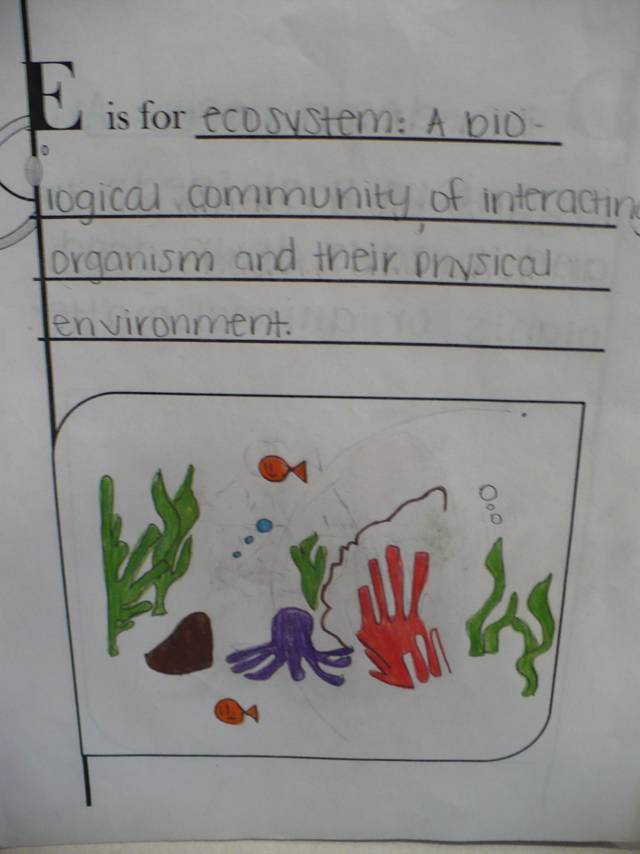
I was so busy at the end of the school year this year I couldn't blog for the life of me!  So I took a little break and I am now back at it!  I want to chat a bit about reviewing those words that are on our word walls at the end of the year.  In science we have about a zillion vocabulary words!  I keep a word wall up all year as we work through them.  At the end of the year, when I have no idea how to keep students engaged, we review these words using definitions and pictures.  My students did a book called The ABC's of Science this year to review our word wall.  Here are some examples of their work.


My 7th grade students seemed to like this review during the last couple weeks of school so I tweaked it a bit and made it into a product that could work for any vocabulary.  You could do the ABC's of Poetry, or the ABC's of The Hobbit!  I will be offering this in my store at a discounted price for the first week it is out so don't wait to grab this one!  It can be found at this link:
http://www.teacherspayteachers.com/Product/ABC-Word-WallVocabulary-Review-Book-726523


Wednesday, April 24, 2013

Biome Dioramas

For my ecology unit this year I had a final written test and a final project.  The project was a biome diorama which we lovingly called a biorama!  Our bioramas were created from a shoebox like a normal diorama but instead of leaving the top open we cut a one inch hole in the side of the box and covered the open part of our box with tissue paper.  You could then look into the hole on the side to see the scene.  My class did some incredible work on this project.  Many used background photos or images to make the scene appear more real.  Still others used different colors of tissue paper depending on their biomes.  If they were creating a savanna biome they might choose yellow paper, or a deep ocean might call for dark green.

Unfortunately, I cannot take credit for this great idea!  I found this wonderful ecology unit complete with this great project on Teachers Pay Teachers.  A store called Getting Nerdy with Mel and Gerdy did all the work and the unit can be found here.

Here are some great pictures of my student's project from this year.  The pictures were taken from the hole in the side of the box.

Sunday, March 3, 2013

Science Outside of the Classroom

The benefits of field trips are important to student learning and provide memorable experiences that enhance what is taught in the classroom.  Many field trips offer students a more hands-on and interactive learning environment than the classroom.  Most students learn best this way!

I basically teach earth science in my classroom.  I can teach through hands-on labs, PowerPoint presentations with great pictures of the concepts, or informational text about what we are learning.  Unfortunately, I learned from my own experiences of getting pictures for a PowerPoint presentation, that going out to take photos of the different rock types or weathering etc. was probably more beneficial than the 
 presentation itself.
Here is a picture of mechanical weathering.  It is a good picture but to actually see it in person is to understand what is happening that much better.  You can touch the rock, see its size, and experience it in a totally different way than in the classroom.  This is a picture of how the granite in the White Tanks Regional Park collects water during the rainy season, hence the name White Tanks.

These catchment areas are stunning and memorable when seen in person, but not so much when only seen in a digital picture.  The entire journey of getting to the area, hiking, eating lunch out in nature, becomes part of the memory of the learning experience.  

I also teach about biomes in my ecology unit. I do use a lot of PowerPoint and photos to try and get my point across.  If you live in a particular biome and can take a field trip to actually see the plants and animals the way they live, your students will be taking away so much more from this experience!  Here is a saguaro cactus from the same area as the other two pictures.
The spidery plant at the right is called an ocotillo. It only becomes green after a rain, otherwise it looks like a bunch of dried sticks.  You can walk right up to these plants and see the little green leaves shooting out from the stick-like skeleton of this plant.  You can't really do that in the classroom.

Not only does this park have great geology and botany, it also has some great cultural features.  Never forget the cultural aspects of a field trip!  Here are some fabulous petroglyphs from this area.

Cultural aspects like these are fun for students to find and hunt for!  It reminds students how humans are a part of the ecosystem and how we used to live.  I would challenge you to find great areas near your school that can offer wonderful learning experiences that enhance your teaching.  Field trips are a must for students now days who don't venture too far from their front door.  How can they know about protecting the natural world if they don't know anything about that world?
View from White Tanks looking into Phoenix

Monday, February 18, 2013

Play Money for a Token Economy

I have used many incentives for good behavior, good work, finished homework, all of the above.  Right now I am using a very nice homework punch card that my students use to earn rewards.  I made it on Vistaprint which I also love!  My students actually ask when they will be getting homework!  Now that's amazing.

Another great idea for any classroom is a token economy and some great play money.  I give my play money out to my 7th graders when they follow the rules, use their social skills, and do excellent work.  Yes, 7th graders really do like it!  Sometimes they use their money for hints in a game we are playing.  Granted, we play very competitive games like The Amazing Science Race in my class so this is important.  Other times I just get a bunch of prizes and do an auction where the students raise the price on the prize.  This is very fun! 

I started making my own money.  I think I should have kept going with that idea and put the templates on sale at Teachers Pay Teachers!  Anyway, I made a printable money file and then put crazy pictures of myself on the money.  The higher the denomination,  the crazier the picture. I added a saying like "Collingwood's Cash"  or "In Collingwood we trust" or something equally goofy.   I like to mix up the money every quarter, however.  I find that middle school kids get bored of anything that is repeated too much.  Here is a free money template:

 
Here is a seasonal money that I like to use.  This one is not free but it is pretty cheap really at $3 and editable.
The Paperglitter site has many cute play money templates which would work in middle school and primary grades.  The Christmas money can be found here:
I actually use a circus theme printable money from Paperglitter at home with my daughter.  She really likes the cute designs. 

If you want to use money that actually looks like real money you may want to check out this site:
http://www.activityvillage.co.uk/printable_play_money.htm
These are free printable money sheets for US dollars and Euros which are very cool.
Here is another totally free printable money site:
http://freeclipartnimages.blogspot.com/2012/05/totally-free-printable-play-money.html
You can print simple but colorful money that looks like this:
Hope your own token economy goes as well as mine has and you have just as much fun!

Friday, February 8, 2013

Science Notebooking

One of the best ideas I integrated into my science classroom is having students keep a science notebook.  All the science teachers in my district decided to adopt this concept a few years back.  The district now purchases a composition notebook for each science student.  Because they are set up the same, a student could leave one school in the district and take their science notebook to the next school.  It works very well. 
I will briefly describe how we set up our notebooks.  This is by no means the only way!  It is just the way we determined we would all set them up.  We start with an "About the Author" page.  Student my draw, doodle, write, paste pictures, etc.  It should be a page that describes them.  I think it creates ownership of the notebook.
We then set up a table of contents.  Every new assignment goes in the table.  A note here, I don't have students number all the pages.  I did that the first year and had students with larger handwriting on a completely different page.  Any assignment or notes, etc. that is new gets a page number. 


We then count five to seven pages from the end of the notebook and make a glossary.  There are so many words in science that it is great to have a place to put them.  We usually draw pictures to go with our definitions.
What can go in your notebook?  Well basically everything.  We of course put notes in ours.  Some are just regular old notes taken from one of my fabulous lectures, but some are fill-in-the-blank notes, or notes with diagrams and pictures.  Generally, if I give a paper for my students to take notes on they must somehow fit in the notebook.  We do this by folding pages in half and making little tabs to hold them closed or just folding them in half and gluing them in.  I also try to have them cut doors and flaps.  Here are some examples:

We also do activities in our notebooks.  Everyday I start with bellwork that I call a "journal".  It is entered by week in the notebook and continues everyday on the same page:
We researched an astronomer this year and made a cute little foldable to write our facts and draw a picture of them.
We also did a rewrite of a children's book Papa, Please Get the Moon for Me and made is scientifically correct using appropriate moon phases.  We constructed an accordion foldable to display our story.  Of course, it went in our notebook!
Thinking maps are also great to put into a notebook:


We also did a topographic map of mars and folded it in half and glued it in there.


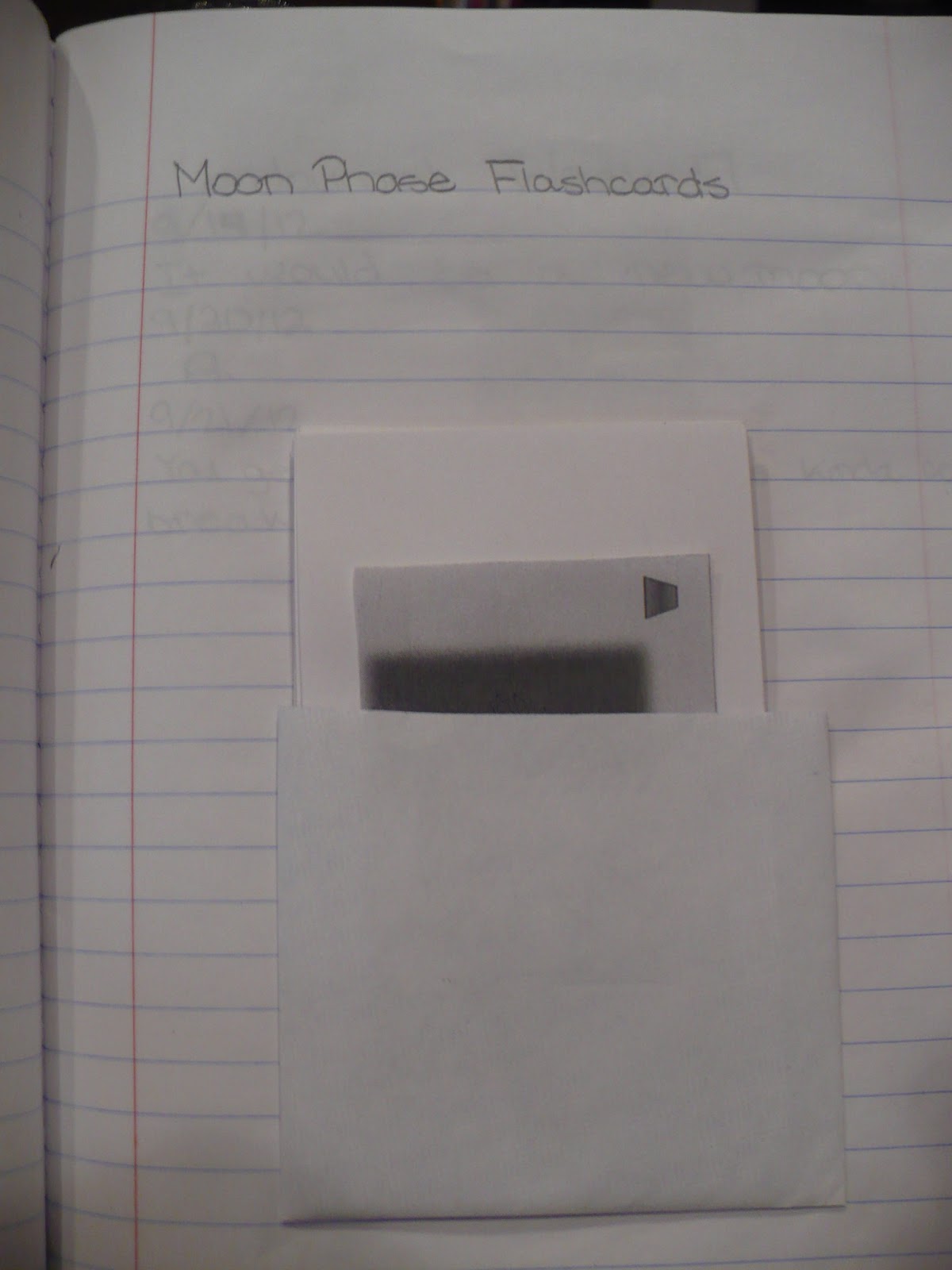
Last but not least, flash cards can be stored in a notebook with the help of half of an envelope.

On a final note, I always have my students use liquid glue for their notebooks.  It just holds much better than a glue stick.  They have gotten very good at "a little dab will do ya!"  and "dot, dot, not a lot!"  Hope you can use some of these ideas in your own classroom.  I find it is an excellent learning tool, as well as, a great record for what I have taught throughout the year!  Some final pictures:
Reflection (self/peer)
Foldable glued sideways   


Related Posts Plugin for WordPress, Blogger...
 

Design by Custom Blog Designs