One of the best ideas I integrated into my science classroom is having students keep a science notebook. All the science teachers in my district decided to adopt this concept a few years back. The district now purchases a composition notebook for each science student. Because they are set up the same, a student could leave one school in the district and take their science notebook to the next school. It works very well.
I will briefly describe how we set up our notebooks. This is by no means the only way! It is just the way we determined we would all set them up. We start with an "About the Author" page. Student my draw, doodle, write, paste pictures, etc. It should be a page that describes them. I think it creates ownership of the notebook.
We then set up a table of contents. Every new assignment goes in the table. A note here, I don't have students number all the pages. I did that the first year and had students with larger handwriting on a completely different page. Any assignment or notes, etc. that is new gets a page number.
We then count five to seven pages from the end of the notebook and make a glossary. There are so many words in science that it is great to have a place to put them. We usually draw pictures to go with our definitions.
What can go in your notebook? Well basically everything. We of course put notes in ours. Some are just regular old notes taken from one of my fabulous lectures, but some are fill-in-the-blank notes, or notes with diagrams and pictures. Generally, if I give a paper for my students to take notes on they must somehow fit in the notebook. We do this by folding pages in half and making little tabs to hold them closed or just folding them in half and gluing them in. I also try to have them cut doors and flaps. Here are some examples:
We also do activities in our notebooks. Everyday I start with bellwork that I call a "journal". It is entered by week in the notebook and continues everyday on the same page:
We researched an astronomer this year and made a cute little foldable to write our facts and draw a picture of them.
We also did a rewrite of a children's book Papa, Please Get the Moon for Me and made is scientifically correct using appropriate moon phases. We constructed an accordion foldable to display our story. Of course, it went in our notebook!
Thinking maps are also great to put into a notebook:
We also did a topographic map of mars and folded it in half and glued it in there.
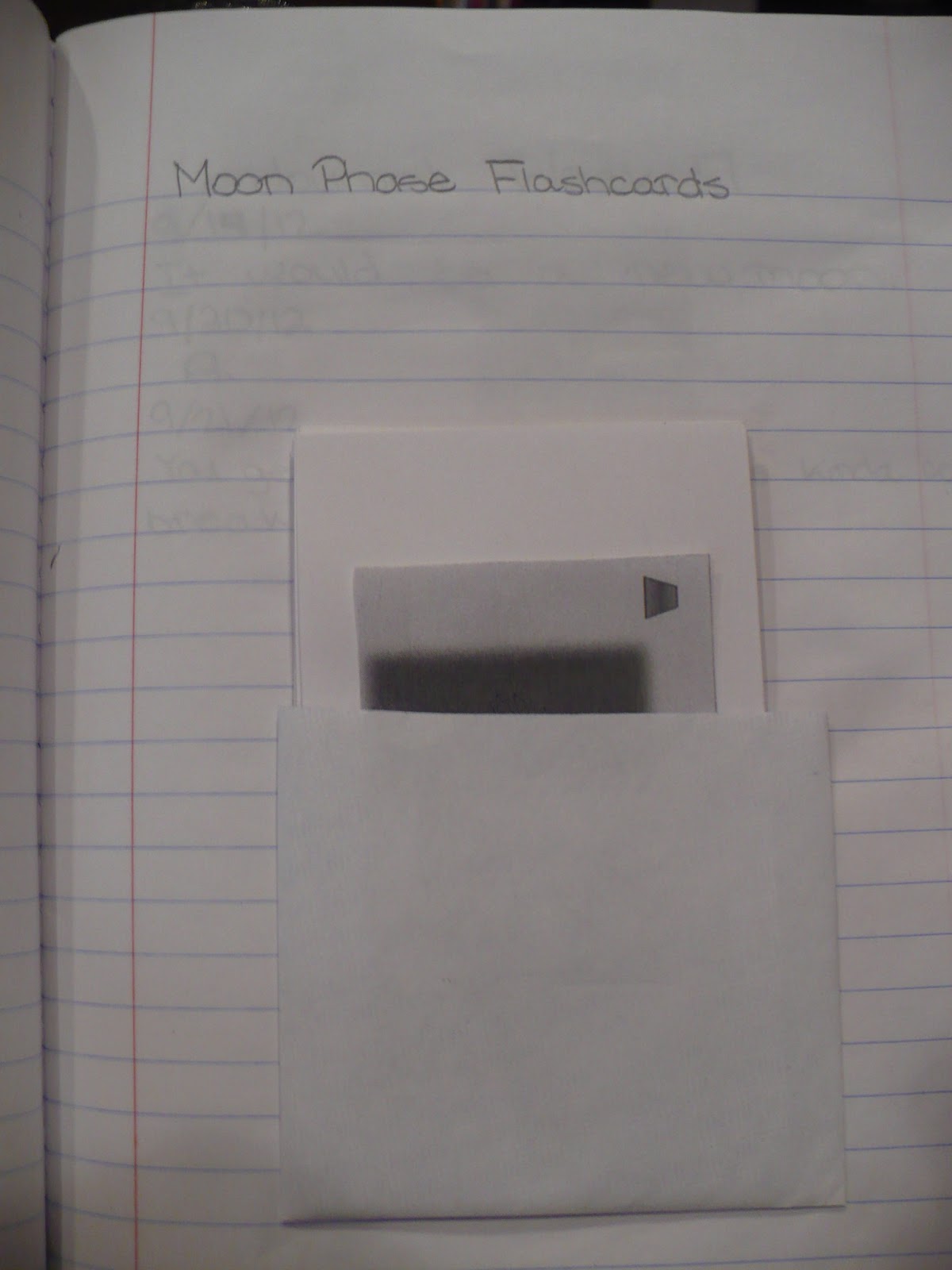
Last but not least, flash cards can be stored in a notebook with the help of half of an envelope.
On a final note, I always have my students use liquid glue for their notebooks. It just holds much better than a glue stick. They have gotten very good at "a little dab will do ya!" and "dot, dot, not a lot!" Hope you can use some of these ideas in your own classroom. I find it is an excellent learning tool, as well as, a great record for what I have taught throughout the year! Some final pictures:
 |
| Reflection (self/peer) |
|
 |
| Foldable glued sideways | | | |
|
|